Miele vs Dyson: Which Vacuum Brand Fits Your Home?
In the US lineup, Miele vs Dyson mostly comes down to vacuum type: Dyson is mainly cordless sticks (plus a robot, an upright and wet cleaners), while the Miele models we list are all corded canisters. Choose by how you clean, not by brand name.
Data last updated:
Miele vs Dyson is less a head-to-head contest than a choice between two kinds of vacuum. In the US models we have on record, Dyson is mostly cordless stick vacuums, with one upright, one robot and two wet-cleaning machines. Every Miele we list is a corded canister. If you want a lightweight cordless machine you can grab for quick cleanups, the Dyson side of a Dyson vs Miele comparison fits. If you want a corded canister with a large dust container for whole-house work, look at Miele.
Miele vs Dyson in short: the main difference is vacuum type
The fairest answer to "which is better" is that they are built for different jobs. Dyson's lineup here leans on battery-powered sticks that double as handhelds, with runtimes ranging from 30 to 70 minutes at the maximum rating. Miele's listings are corded canisters with a hose and wand, a floor head and, in most cases, a dust container of 2 to 4.5 liters.
That corded versus cordless difference drives almost everything else: weight, how long you can clean before stopping, how you empty the machine, and how much the vacuum has to carry on your arm versus roll behind you.
Dyson and Miele at a glance
| Dyson (US models in our catalog) | Miele (US models in our catalog) | |
|---|---|---|
| Main vacuum type | Cordless stick; also an upright, a robot and wet cleaners | Corded canister |
| Weight range | 4.0 lb (1.8 kg) PencilVac to 17.3 lb (7.85 kg) Ball Animal 3 upright | 11.5 lb (5.2 kg) to 19.0 lb (8.6 kg) |
| Dust container | From 0.08 L (PencilVac) up to 1.9 L (Gen5outsize Absolute) on sticks | 2.0 to 4.5 L |
| Maximum runtime | 30 to 70 minutes on cordless models | Corded, so no battery limit |
| Warranty | 2 years on most models, 5 years on the Ball Animal 3 | 1 to 3 years, depending on model |
Warranty terms vary by model and retailer, so confirm the exact terms on the product page you buy from.
What Dyson offers in the US lineup
The core of the range is the stick vacuum. The V15 Detect Absolute lists up to 60 minutes of runtime, 240 W of suction, a 0.76 L bin, HEPA filtration and a weight of 6.8 lb (3.1 kg). Its listed features include laser dust detection and a screen that shows particle counts. The Gen5detect Absolute raises the runtime to 70 minutes, at 7.7 lb (3.5 kg). The Gen5outsize Absolute has a much larger 1.9 L bin at 8.6 lb (3.9 kg), which helps if you do not want to empty the bin often. For a broader view of the range, see our Dyson cordless vacuum cleaner page.
At the light end, the PencilVac models weigh 4.0 lb (1.8 kg) and are built for quick hard-floor cleanups. Their tradeoff is plain in the specs: a 0.08 L bin and about 30 minutes of maximum runtime. The V8 and V8 Absolute sit lower in the range, with a 0.53 L bin and up to 40 minutes.
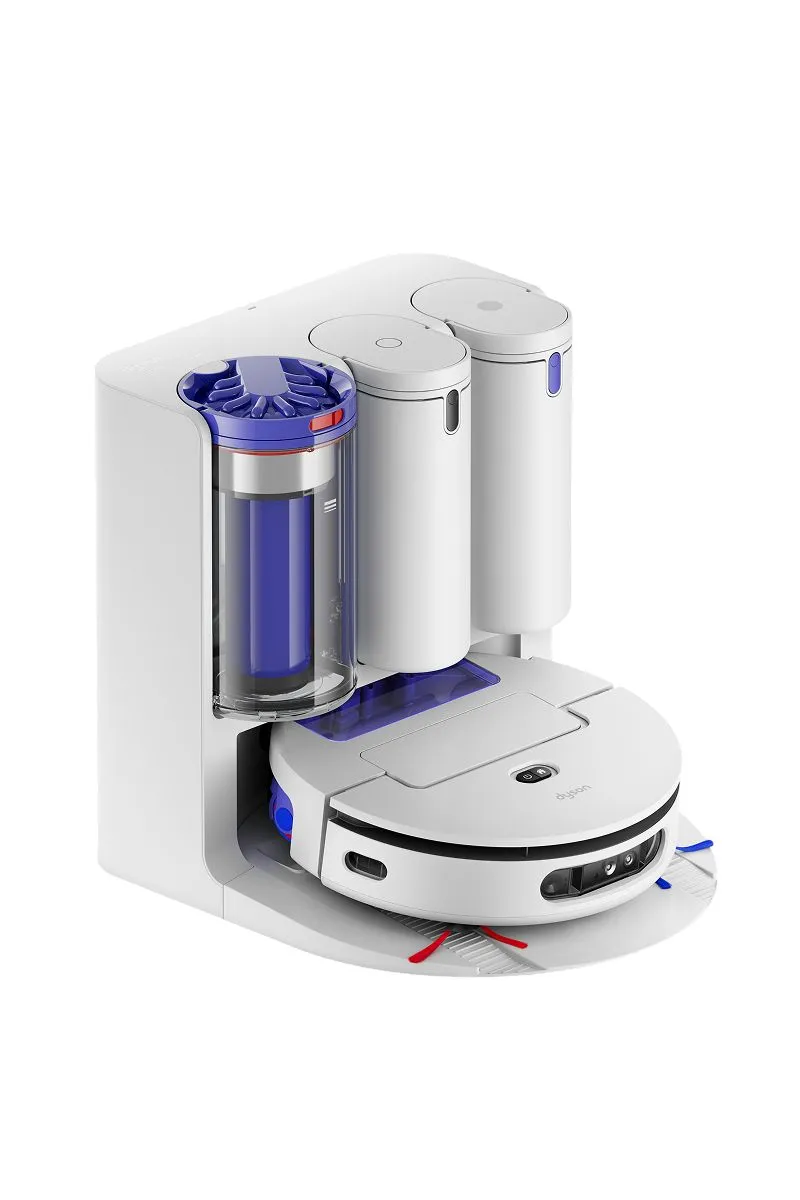
Beyond sticks, Dyson's range includes the Ball Animal 3 upright (7.85 kg, 17.3 lb, 1.7 L bin, HEPA, 5-year warranty), the R3 Nurovi Spot+Scrub UV robot, and two wet cleaners, the PencilWash and WashG1, for hard floors. You can browse every model on the Dyson brand hub hub.
What Miele offers in the US lineup
The Miele models here fall into three families. The Classic C1 line is the lighter end: the Pure Suction weighs 11.5 lb (5.2 kg), the Turbo Team 12.8 lb (5.8 kg), and all carry a 4.5 L (about 4.8 qt) dust container with a 6-stage suction control. The Guard line, including the Guard L1 Electro and Guard M1 Cat & Dog Turbo Team, weighs 6.7 to 7.3 kg (14.8 to 16.1 lb) and lists noise levels of 73 to 75 dB. The Blizzard CX1 PowerLine models are heavier at 19.0 lb (8.6 kg), with a 2.0 L container on two of them and a 1200 W Vortex motor.
No Miele model covered here is battery powered, so they suit people who vacuum a whole floor at once and do not mind a cord. Explore them on the Miele canister vacuum page.
The Miele canister vacuums page lists those corded models by type, and upright versus canister explains how the two corded designs differ.
Filtration, noise and upkeep
Both brands list HEPA filtration on some models, not all of them. On the Dyson side, the V15 Detect Absolute, V12 Detect Slim, Gen5 models, V10 Konical, V16 Piston Animal and Ball Animal 3 are marked as having HEPA filters. The PencilVac models and WashG1 are not listed with HEPA filtration. Among Miele models, the Guard L1 Electro, Classic C1 Pure Suction HomeCare and the Blizzard CX1 TurboTeam and Cat & Dog PowerLine models are marked HEPA, while the Classic C1 Turbo Team and one Guard L1 variant are not.
Upkeep differs by design. The Guard M1 lists a FilterBag, so you replace bags and filters rather than empty a bin. The Blizzard CX1 PureSuction is described as bagless with separate coarse and fine dust emptying. Dyson sticks use bins you empty by hand, and cordless models also depend on a battery whose replacement cost and availability are worth checking before you buy.
Noise is recorded for only some Miele models (73 to 75 dB) and none of the Dyson ones, so the specs cannot settle which is quieter.
Drawbacks to weigh on each side
- Dyson sticks: runtime is capped, bins are small compared with a canister, and the lightest PencilVac models trade capacity and suction (55 W maximum) for low weight.
- Miele canisters: they are corded, several weigh more than most Dyson sticks, and Miele lists no stick or robot option. Some Miele records have gaps, such as warranty or noise.
- Data sources: some figures come from secondary sources, and some figures come from non-US sources. Check current specs on the manufacturer or retailer page before buying.
How to choose between Dyson and Miele
When deciding whether Dyson or Miele is right for you, start with the job:
- Quick daily cleanups, stairs, small apartments: a cordless stick is easier to grab, so start with Dyson.
- Large areas of hard floor or low to medium carpet cleaned in one session: a corded canister with a 4.5 L container removes the runtime limit, which points to Miele's Classic C1 line.
- Pet hair: both brands label models for it, such as the Miele Guard M1 Cat & Dog and the Dyson V16 Piston Animal. The specs do not show which performs better.
- Allergies: look for a HEPA-marked model.
- Wet floor cleaning: only Dyson has wet cleaners among the models covered here.
If neither brand fits, you can compare more models from other makers, such as a Bissell vacuum, or start from our overview of the popular vacuum cleaner options for each type.
Other Dyson brand matchups: see how SEBO compares with Dyson for bagged corded machines, or read Tineco against Dyson.
Stick shoppers can also read Shark versus Dyson for the cordless side.
Does Miele make cordless stick vacuums?
Not in the US models we have on record. Every Miele listed here is a corded canister vacuum, covering the Classic C1, Guard and Blizzard CX1 families, with dust containers from 2.0 to 4.5 liters. Miele may sell other types elsewhere or in the future, so check Miele's US site for the current range before ruling it out. If you specifically need a battery-powered stick, Dyson is the brand in this pairing that lists them, with runtimes from 30 to 70 minutes at maximum rating depending on the model, for example up to 60 minutes on the V15 Detect Absolute.
Which is heavier, a Dyson or a Miele?
It depends on the model. Dyson's cordless sticks are the lightest, from 1.8 kg (4.0 lb) for the PencilVac to 3.9 kg (8.6 lb) for the Gen5outsize Absolute, though its Ball Animal 3 upright is 7.85 kg (17.3 lb). Miele's canisters run from 5.2 kg (11.5 lb) for the Classic C1 Pure Suction up to 8.6 kg (19.0 lb) for the Blizzard CX1 models. A canister rolls on wheels, so its weight matters less than a stick's, which you carry. Weights can differ slightly by source.
Do Dyson and Miele vacuums have HEPA filters?
Some models from each brand do. Dyson models such as the V15 Detect Absolute and Ball Animal 3 are listed as HEPA, while the PencilVac sticks are not. For Miele, the Guard L1 Electro, Classic C1 Pure Suction HomeCare and the Blizzard CX1 TurboTeam and Cat & Dog PowerLine models are listed as HEPA; the Classic C1 Turbo Team is not. Filtration varies by model rather than by brand, so check the specific model's spec sheet, and treat a HEPA label as a filter feature rather than a health claim.